
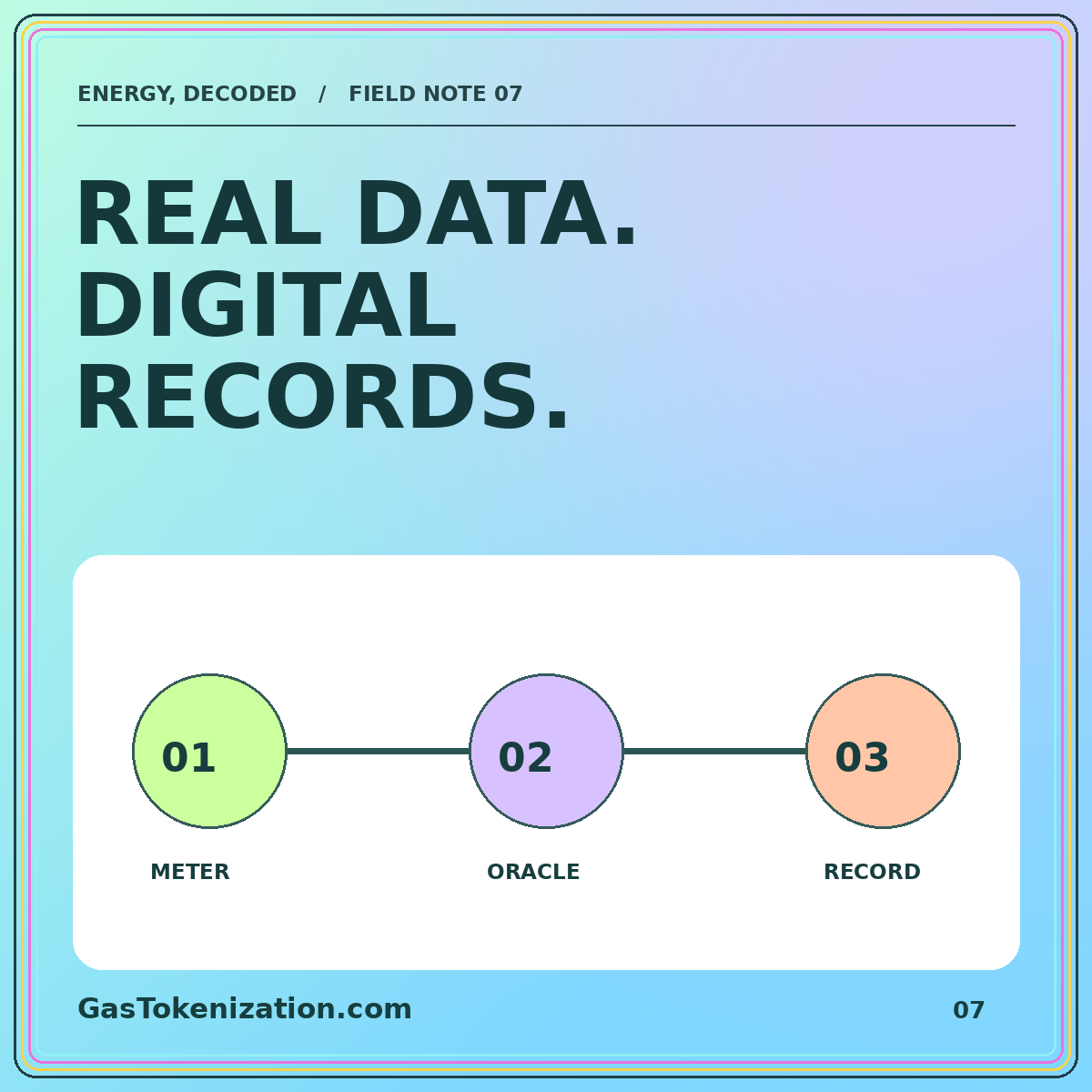
A digital token can contain a balance without knowing anything about a physical gas meter. If a proposed energy application needs information about a delivery, a measurement, or an operating event, someone must supply that information through a defined process. The quality of that connection matters as much as the software that stores the resulting record. A dependable-looking dashboard can still display an incorrect or incomplete input.
This guide examines a hypothetical meter-to-record workflow for gas energy blockchain applications. It is a design review, not production engineering advice or a description of an operating service. The goal is to identify where information originates, how it changes, who approves it, and what the system should do when the evidence is uncertain.
Understand the oracle's narrow role
The Ethereum documentation on oracles explains that oracles make off-chain information available to smart contracts, which cannot access outside data by default. That provides the technical baseline. The oracle supplies information to the system; the mere presence of an oracle does not establish that a meter was accurate, a document was authentic, or a commercial obligation was fulfilled.
Define the question before the data feed
For the hypothetical energy application, begin by naming the actual question the software needs answered. “What quantity was accepted for this delivery period?” is more useful than “Connect the gas data.” A precise question reveals the required unit, time interval, source, and approval method. It also makes it possible to distinguish an operational reading from a final quantity accepted for settlement.
Define the data contract before the software contract
Create a written specification for the input record. In the example, it might include a facility identifier, observation interval, measurement unit, original source, quality status, revision number, and responsible signer. Each field should have a clear meaning. A timestamp should say whether it records measurement time, publication time, or receipt by the digital system; those moments are not interchangeable.
Specify how missing values differ from zero values. Define how corrected readings are represented and whether estimates are permitted. A system that treats missing data as a zero quantity could reach a very different result from one that marks the period unresolved. The data specification should make these distinctions before anyone designs an attractive chart or an automated payment trigger.
Trace the information through every handoff
Draw the example workflow from the measuring device to the operating record, through any aggregation or review, and finally to the digital publication step. At each handoff, identify who can alter the information and what record of the change is retained. This exercise often reveals that the published number is not a raw measurement but the output of several processing decisions.
A hypothetical reviewer should be able to reconstruct the path in reverse. Starting from the value used by the smart contract, can they identify the approved record and the underlying observation? If the answer depends on one person's memory or an undocumented spreadsheet, the evidence trail is incomplete. The verification article offers a broader method for organizing supporting records and known limitations.
Separate authentication from accuracy
In a proposed system, a digital signature may help establish that an approved source submitted a record. That is different from demonstrating that the record is factually correct. The review should therefore ask two questions: was the message submitted through the authorized process, and what supports the content of the message? A design that answers only the first question leaves the second unresolved.
Consider a hypothetical authorized operator who submits the wrong reporting period by mistake. The message could pass an authorization check while still being unsuitable for the calculation. Useful controls would compare expected intervals, identifiers, and allowed ranges, then route unusual submissions for review. These are proposed safeguards, not a claim that any particular control eliminates error.
Design for stale or missing information
Choose a hypothetical maximum age for a record based on the business process, then explain why that age is appropriate. The application should distinguish a recently received old observation from a genuinely recent observation. Otherwise, a fresh upload could create the impression that the underlying physical information is current when it is not.
Next, define the response to missing data. The example system could pause a dependent calculation, retain the last value with a visible warning, or require manual review. Each choice has consequences, and none should happen silently. The appropriate response depends on the actual obligation. A payment calculation and an informational dashboard may reasonably need different failure behavior.
Handle disagreement explicitly
Suppose two approved sources provide different quantities for the same hypothetical delivery period. Averaging them may be inappropriate if they measure different points, use different periods, or carry different approval status. Before combining values, establish whether they answer the same question. A disagreement can be useful evidence of a process issue rather than noise that should automatically be smoothed away.
Define an exception record that preserves both submissions, their provenance, and the reason for the resolution. Identify who may resolve the disagreement and whether the resulting decision can be challenged. The workflow should also specify what happens to affected token actions during the review. A transparent unresolved status can be more informative than an unsupported single number presented as final.
Consider privacy and access separately
A hypothetical energy record may contain commercially sensitive information. The design should identify which details need broad visibility and which should remain available only to authorized reviewers. Publishing every document publicly is not the only way to maintain an evidence trail, but a private reference must still be accessible to the parties who have legitimate review rights.
A proposed file fingerprint can help compare a retrieved document with the version referenced by the system. It does not make an unavailable document readable or establish the truth of its contents. Ask how access survives staff changes, vendor outages, and the end of a service relationship. Evidence that cannot be retrieved when needed offers limited practical value.
Align the oracle with the holder's actual right
The data input should match the claim being administered. In a hypothetical delivery entitlement, a quantity accepted at a named point may be relevant. In a revenue-sharing structure, the relevant input may instead involve defined receipts and deductions. Publishing a physical production reading would not automatically establish the payment due under a different contractual formula.
This is why the tokenized gas rights framework belongs before the technology design. Once the right is clear, the team can identify which facts are needed to administer it. Starting with an available data feed and inventing an economic promise around it risks producing a system that is technically coherent but disconnected from the intended obligation.
Test ordinary mistakes and adversarial scenarios
A useful test plan covers duplicated messages, swapped identifiers, out-of-order revisions, unavailable sources, and records outside their approved period. It should also consider an authorized account being misused or a source submitting a plausible but unsupported number. Document what the system detects, what requires human review, and what remains outside its detection capability.
The test result should describe the actual scenario and observed behavior rather than claiming that the oracle is simply “secure.” Include the process for revoking a compromised source and restoring ordinary operation. A recovery plan needs accountable people and retained evidence, not only an emergency software function. Independent technical assessment is appropriate before any real financial or operational deployment.
Evaluate usefulness beyond transaction speed
In a pilot, compare the time needed to resolve a disputed record with and without the proposed system. Measure whether reviewers can reconstruct the source trail and whether users understand the status labels. A faster publication step has limited value if it makes an unresolved value look authoritative or moves the correction work to another team without reducing it.
Document the pilot's scope and limitations. A successful demonstration of signed submissions does not prove the quality of the underlying measurement process, and a readable dashboard does not establish an enforceable commodity claim. The energy blockchain topic page places oracles alongside permissions, reconciliation, and exit procedures so that their role remains appropriately bounded.
Conclusion: trust requires a traceable process
An oracle is a connection between a digital system and supplied information. In gas tokenization, the useful question is whether the entire process makes that information understandable, reviewable, and correctable. Identify the source, define the meaning, retain the evidence, and make uncertainty visible. Those principles are more informative than treating the word “oracle” as a guarantee.
Continue with the smart contract controls guide to examine what happens after information reaches the digital system. Any real implementation needs specialist review of its measurement, commercial, security, and legal context. This hypothetical workflow is a starting point for questions, not a production specification.


