
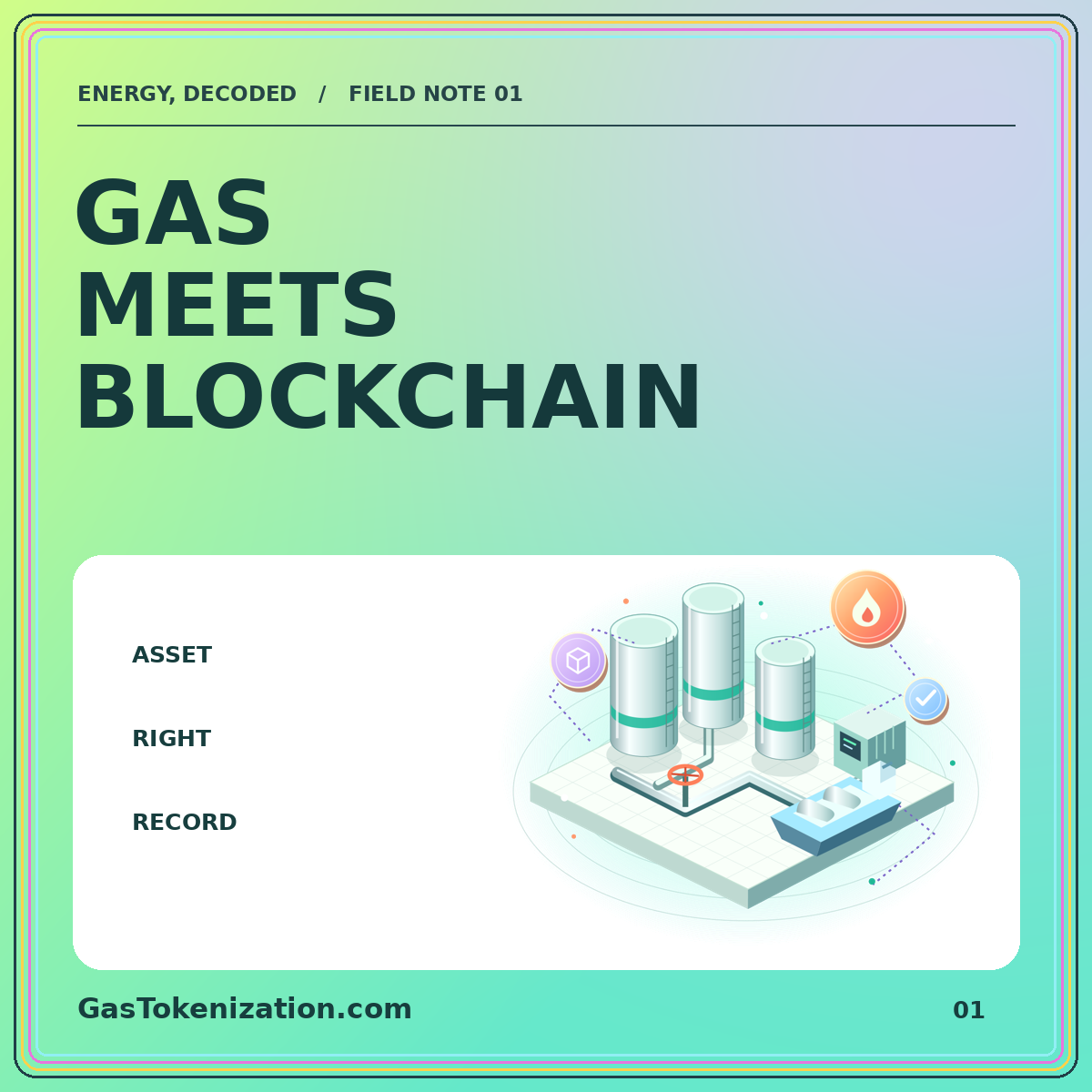
Gas tokenization starts with an ordinary question: what does the holder actually receive? The answer is more important than a token symbol, a blockchain name, or an attractive image of a gas field. A digital record can describe a commodity-related right, but the nature of that right must be defined separately. Someone researching this subject should be able to trace the proposed asset from its description to its supporting evidence and then to its delivery or payment terms.
This guide uses gas tokenization to mean the digital representation of specified natural gas-related rights. It does not mean Ethereum transaction fees, and it does not describe a product sold by this website. The examples below are hypothetical design exercises. Their purpose is to make unfamiliar structures easier to question, not to suggest that a particular investment is available or appropriate.
Start with the right, not the token
The Bank for International Settlements' explanation of tokenisation describes the representation of asset claims on programmable platforms and emphasizes that intermediaries still have roles. That is a useful conceptual starting point. The record and the arrangements supporting it need to be examined together. A transfer mechanism alone cannot explain who owes a holder something, what that something is, or how a disagreement would be resolved.
The one-sentence claim test
For a practical first pass, write a plain-language sentence: “This token records a claim against this identified party for this specified benefit, subject to these conditions.” Leave missing information visibly blank rather than filling it with assumptions. A project that cannot complete that sentence has not yet supplied enough information for a meaningful comparison. Our tokenized gas overview explores several possible claim types in more detail.
Separate three layers of the system
The first layer is the physical or economic asset. In a hypothetical project, this might be stored gas, a contractual delivery entitlement, or a defined share of receipts from production. The second layer is the documentation that connects that asset to an identifiable obligation. The third layer is the digital system used to record balances, permissions, or transfers. Keeping these layers separate makes it easier to identify exactly what a proposed system changes.
Imagine a storage operator already keeps an inventory ledger and a customer owns a contractual entitlement. A proposed token might become an additional record of that entitlement. Before calling this an improvement, ask which record controls when the two disagree. Ask who can correct an error and whether the customer can still enforce a claim when the website is unavailable. Those are design questions, not details to postpone until after launch.
Define the unit before discussing value
A useful token description names the unit being represented. It should also say whether the entitlement concerns a quantity of energy, a volume under specified measurement conditions, a fraction of an entity, or a share of a payment. These alternatives should not be compared as though they were interchangeable. The phrase “one gas token” is a product label, not a complete economic specification.
For example, suppose a proposal describes one token as a claim to one hypothetical energy unit at a named facility. The next questions concern the measurement standard, eligible delivery period, quality requirements, and costs. If a different proposal describes one token as a share of net revenue, the important questions instead include permitted deductions, payment timing, and reporting rights. The labels might look similar while the obligations are fundamentally different.
Follow a complete hypothetical lifecycle
Begin before issuance. Identify the evidence that would permit a new token to exist, the person who checks that evidence, and the approval record. Then trace issuance to an eligible holder. Ask whether the holder receives the governing documents at the same time and whether a record of acceptance is retained. An understandable process should show the conditions for each step rather than merely presenting a list of technical functions.
Next, examine an ordinary transfer. In the example system, does the recipient need approval, and when does the corresponding off-chain register change? Finally, examine redemption. A token might be locked while a delivery request is processed, then retired only after the obligation is completed. The precise sequence should be documented. Otherwise, a failed delivery could leave the customer without either the gas entitlement or the original token balance.
Identify benefits as testable hypotheses
A proposed project might aim to reduce repeated data entry, make ownership records easier to reconcile, or automate certain eligibility checks. Treat each of these as a hypothesis with a measurable baseline. Compare the proposed workflow with the existing one, including exception handling. Counting only the easiest transfer while ignoring onboarding, reporting, reconciliation, and disputes produces an incomplete comparison.
A practical evaluation could measure how many manual corrections are required in each workflow and how long an unresolved exception remains open. It could also compare the cost of maintaining the same evidence in both systems. There is no need to assume that more technology means less administration. The interesting question is whether the design improves a specific task without creating a larger problem elsewhere.
Ask what remains outside the blockchain
In a physical commodity example, the token's usefulness depends on information and actions beyond its own ledger. A meter reading must be interpreted, an operator must perform an obligation, and documents must identify the relevant rights. The digital system may record an assertion about these events, but a careful reader should still ask who originated it and who can challenge it.
This is why an evidence map belongs beside the technology diagram. List the document, responsible organization, effective date, review method, and known limitations for each important claim. Link every token-related promise to an item on that map. When a promise has no supporting record, mark it unresolved. Our reserve verification guide provides a framework for organizing that review without treating a dashboard badge as proof.
Work through an ordinary failure
Consider a hypothetical outage that prevents a storage operator from completing a planned delivery. Ask what the holder receives during the delay, who communicates updates, and whether the governing documents provide any alternative. Now add a second problem: the digital platform remains online, so transfers continue while the physical issue is unresolved. A design should explain how buyers learn about that limitation before accepting the claim.
A second exercise is a record mismatch. The token ledger says a customer has a balance, while the operator's register shows a different quantity. Which team investigates, what evidence is preserved, and what happens to new issuance? A useful system has an exception path that is understandable to non-developers. A fast normal workflow does not compensate for an undefined recovery process.
Choose a sensible learning sequence
Start by learning the asset vocabulary. Then compare the possible rights, inspect the supporting evidence, and read the transfer and exit terms. Only after those steps does it make sense to examine network choice, contract design, or wallet compatibility. This sequence keeps the technical presentation from obscuring the economic arrangement it is supposed to support.
Keep a short research record with three headings: established information, unanswered questions, and assumptions used in examples. That distinction helps when comparing proposals or discussing them with a qualified adviser. It also makes later updates easier: a revised document can change one specific conclusion without requiring the entire analysis to be reconstructed from memory.
Conclusion: make the connection explicit
Gas tokenization is most understandable when every digital record points to a clearly specified right and an accountable process. The core exercise is not predicting which token will become popular. It is following the connection between asset, obligation, evidence, holder, and exit. When that connection is incomplete, technical polish should not be mistaken for a substitute.
Continue with our guide to reserves, inventory, and revenue rights to compare the underlying structures. Before considering any real transaction, obtain advice appropriate to the instrument and jurisdiction, and read the risk information. This educational framework cannot determine the suitability, enforceability, or value of an individual offering.


