
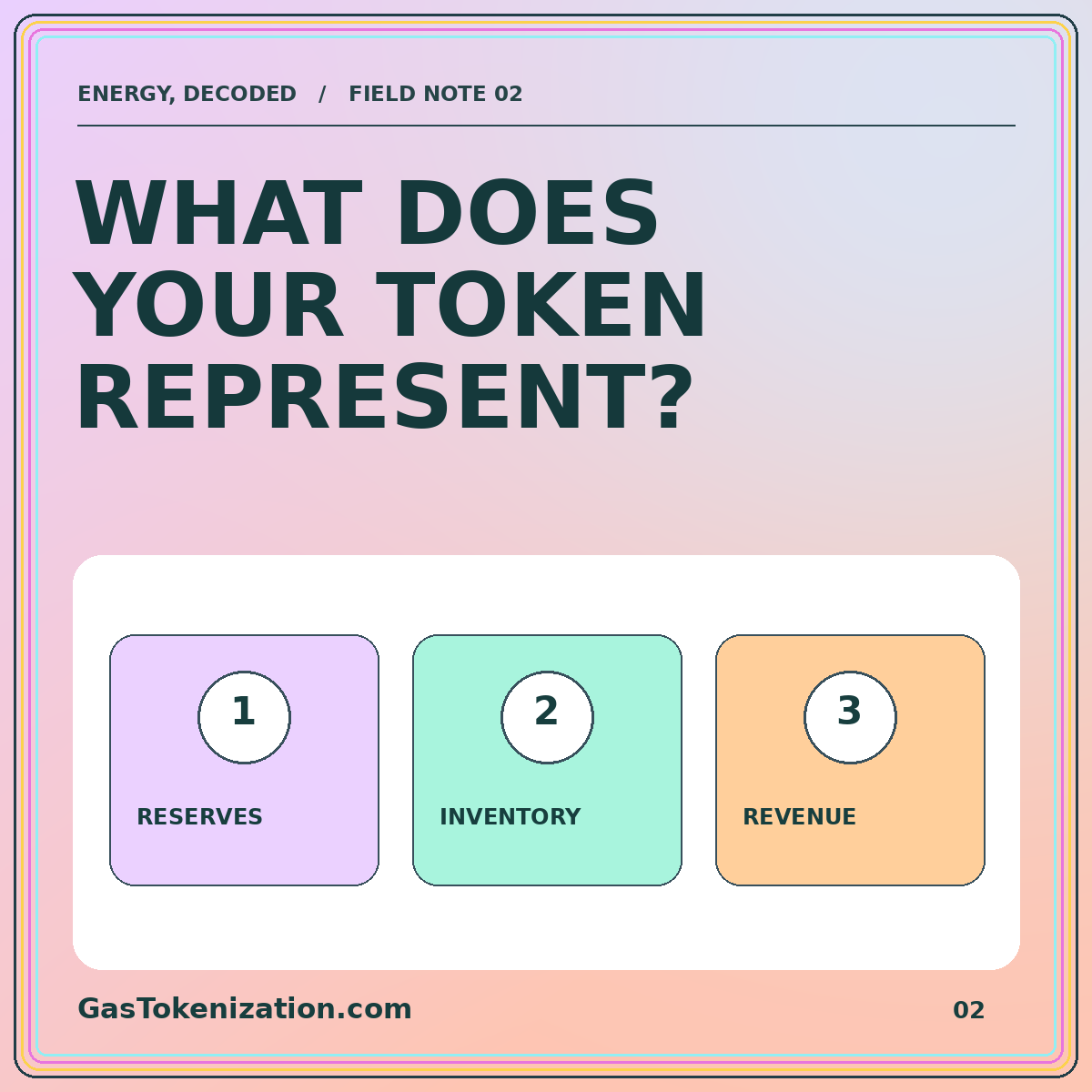
“Backed by natural gas” is an incomplete description. It might refer to a proposed interest in a producing business, a claim on stored inventory, a future delivery obligation, or a payment calculated using a commodity reference. Each structure asks the holder to rely on different evidence and different counterparties. Comparing them by token price alone would skip the most important part of the analysis.
This article offers a classification exercise for readers of tokenized gas materials. None of the structures described is an offering from GasTokenization.com. The examples are deliberately hypothetical. Their purpose is to help you identify which questions belong to which claim, so that a statement about one structure is not accidentally carried over to another.
Reserves are not the same as inventory
The U.S. Energy Information Administration explains that proved reserves are estimates recoverable with reasonable certainty under existing economic and operating conditions. Its overview of U.S. proved oil and gas reserves also explains that estimates change with prices, costs, production, discoveries, and technical developments. A reserve estimate therefore describes something different from gas already measured into an available storage position. This distinction matters before any digital record is introduced.
Identify the holder’s interest
For a hypothetical reserve-linked token, ask which interest connects the holder to the resource. Is the token associated with an ownership interest in an entity, a share of certain receipts, or another defined obligation? A geological report may support an estimate, but it does not by itself describe the holder's contractual position. The gas reserves learning hub separates geological evidence from the financial terms that require their own review.
Inventory claims need location and control
Consider a hypothetical inventory structure in which an identified party promises delivery of a specified quantity of stored gas. A useful description should name the facility or delivery system, the measurement basis, and the conditions for making a request. It should also explain how the operator confirms the quantity available for that obligation. A photograph of a storage installation would not answer those questions.
Control deserves separate attention. Ask which party maintains the relevant register, who may authorize a withdrawal, and whether another claim can be created against the same inventory. In this example, a token balance is useful only if its relationship to that register is defined. Readers should also ask whether the holder's entitlement is segregated, pooled, or subject to substitution, rather than assuming one model from a general marketing phrase.
Delivery rights need a complete performance schedule
A future delivery entitlement differs from an immediate claim on available inventory. In a hypothetical contract, performance might depend on a delivery window, a specified connection point, and operational requirements. The review should identify what must happen before the holder can request delivery and what counts as completed performance. This is a schedule of obligations, not merely a quantity written beside a token symbol.
Consider a buyer who holds the example token but cannot receive gas at the named delivery point. Does the agreement permit a cash alternative, an assignment, or an approved delivery agent? Is any alternative optional for the issuer rather than guaranteed for the holder? These distinctions should be answered in the documents. Do not treat a proposed right as practically usable until the steps required to exercise it are understood.
Revenue rights require a payment definition
A revenue-linked structure can be described through a hypothetical waterfall. Start with specified receipts, subtract only the categories authorized by the agreement, account for any required reserves, and identify the amount available for distribution. The useful questions concern the permitted deductions and the order of payments. “Earn from production” would not tell a reader whether the relevant amount is gross revenue, net revenue, or another calculation.
An example helps expose the difference. Suppose two imaginary instruments each refer to ten percent of something called “gas income.” One agreement measures receipts before operating costs; the other measures a residual after defined costs and prior obligations. The same percentage would not create the same claim. Any numerical comparison should therefore wait until the payment base, reporting period, and calculation method have been specified.
Entity interests add another layer
A proposal could connect a token to an interest in a company or another legal arrangement associated with gas assets. In that case, the reader should examine the entity and its obligations, not only the commodity story. Ask which assets and liabilities are inside the arrangement, what decisions management may make, and what information holders receive. The token representation does not explain those details by itself.
For this hypothetical structure, useful documents might include the governing agreement, the capital structure, financial reporting, and restrictions on transfers. A reader should ask whether new interests can be issued and how the terms address conflicts. These are prompts for a qualified professional review, not a conclusion that a particular document or legal structure is sufficient in every jurisdiction.
Price exposure is another distinct objective
Some product descriptions emphasize tracking a gas-related price rather than obtaining delivery or sharing production receipts. Treat this as a separate classification. In a hypothetical price-linked agreement, the questions begin with the reference price, observation time, settlement method, and adjustments. A product associated with a benchmark need not represent ownership of gas at a facility.
Compare two imaginary outcomes. The physical market reference rises, but the example holder cannot exit because the agreement has a later settlement date. Alternatively, the reference barely moves while an agreed fee reduces the eventual payment. Neither situation can be evaluated by looking only at the commodity headline. The relationship between reference movement and holder outcome must be written down before it can be analyzed.
Use a rights comparison worksheet
Create one column for each proposal and one row for each essential question. Record the obligated party, claim type, underlying asset, evidence date, unit, payment or delivery conditions, permitted transfers, and exit process. Add a final row for unresolved issues. An unanswered question should remain visible; “not provided” is more informative than a guess that makes the columns look complete.
Next, read across each row. If the units or claim types differ, avoid compressing the comparison into a single token price. The worksheet should reveal differences rather than erase them. It can also guide follow-up requests: instead of asking a vague question about backing, ask for the specific record that establishes the proposed holder's right against the identified party.
Watch for shifts in terminology
One warning sign in a research exercise is a description that changes claim type between sections. The introduction may talk about ownership, a diagram may show stored gas, and the terms may describe only a payment obligation. That inconsistency deserves clarification. It is not resolved by choosing whichever sentence seems most attractive or assuming that the illustration carries the same meaning as the agreement.
Keep copies of the materials being reviewed and note their dates. Ask the issuer or responsible party to reconcile the language in writing. A clear answer should identify the controlling documents and explain how the simpler description relates to them. Our evidence-trail article explains how to organize this kind of record review without claiming that a tidy file proves every underlying assertion.
Conclusion: classification comes first
Reserves, inventory, delivery, revenue, entity interests, and price exposure are not interchangeable labels. The first useful result of research is a clear classification of the holder's claim. After that, evidence and risk can be examined on terms that fit the actual structure, rather than borrowed from a different commodity product or a generic blockchain explanation.
Use the tokenized gas topic page as a starting reference, then examine the gas reserves due diligence framework when an underlying resource estimate is involved. Any real arrangement requires its own professional assessment. This article supplies questions for that assessment; it does not establish ownership, verify backing, or recommend participation.


